Large-Screen Molten Iron & Steel Thermometer: Working Principle, Key Components & Selection Guide
Introduction
In the core stages of industrial production across casting and metallurgy, precise temperature control of molten iron and steel is a key factor determining product quality, energy consumption, and even production safety. Too high a temperature can cause metal burn loss, coarse grain structure, and increased energy consumption. Too low a temperature can cause casting defects such as misruns and cold shuts.
As the production floor's "eyes," the Large-Screen Molten Iron & Steel Thermometer — its measurement accuracy and reliability directly affect process stability and product quality.
1. Core Technical Principle: From Thermoelectric Effect to Instantaneous Capture
The core working principle of a modern large-screen molten iron & steel thermometer is based on the Seebeck thermoelectric effect. Simply put, when two dissimilar conductors (or semiconductors) A and B are connected in a closed loop, an electromotive force is generated if the two junctions are at different temperatures — producing a current. This physical phenomenon forms the sensing basis of thermal analyzers and smelting thermometers.
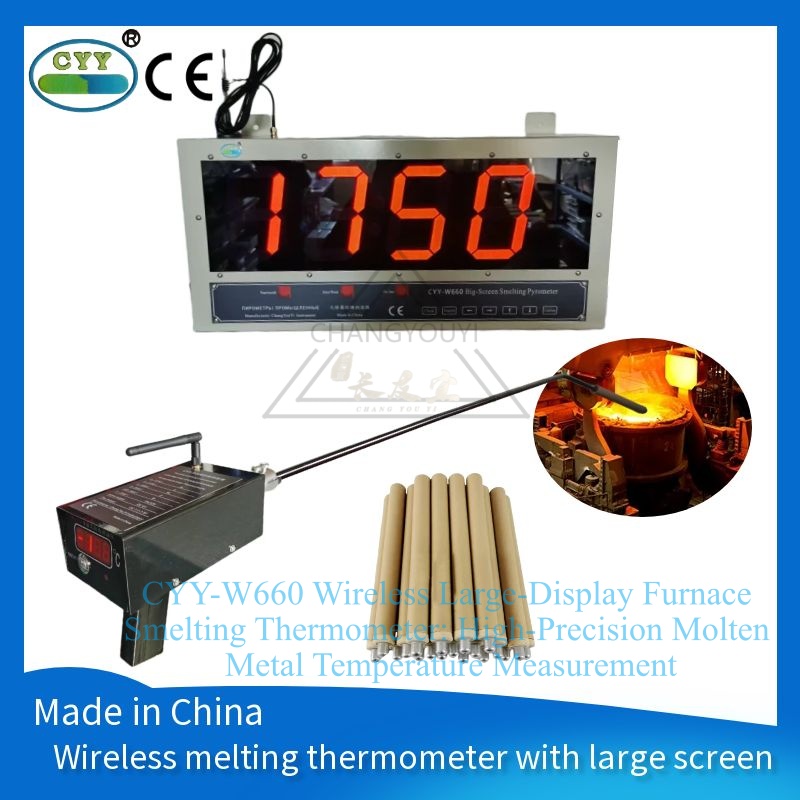
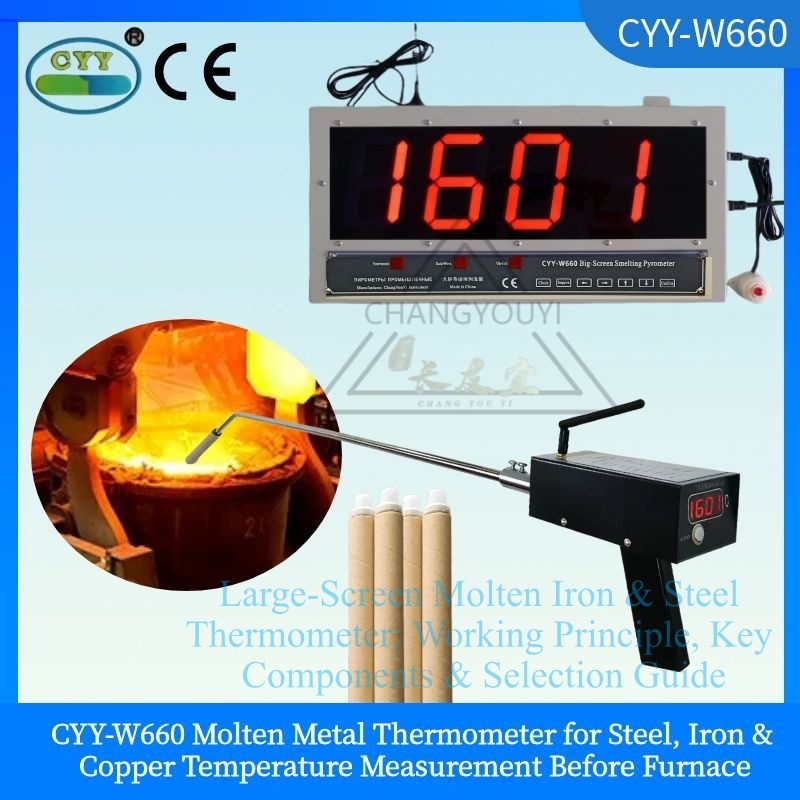
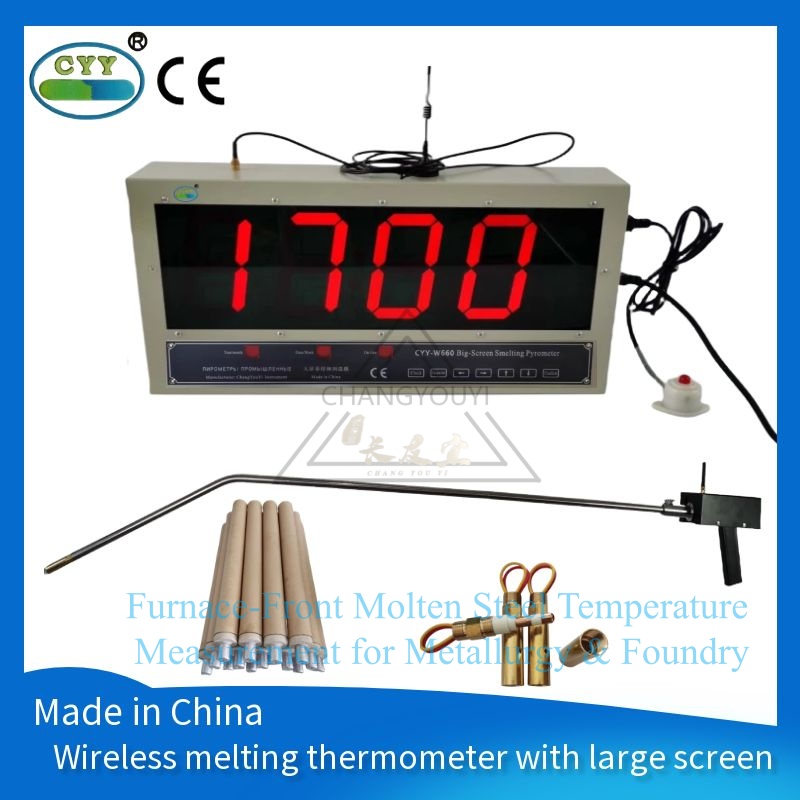
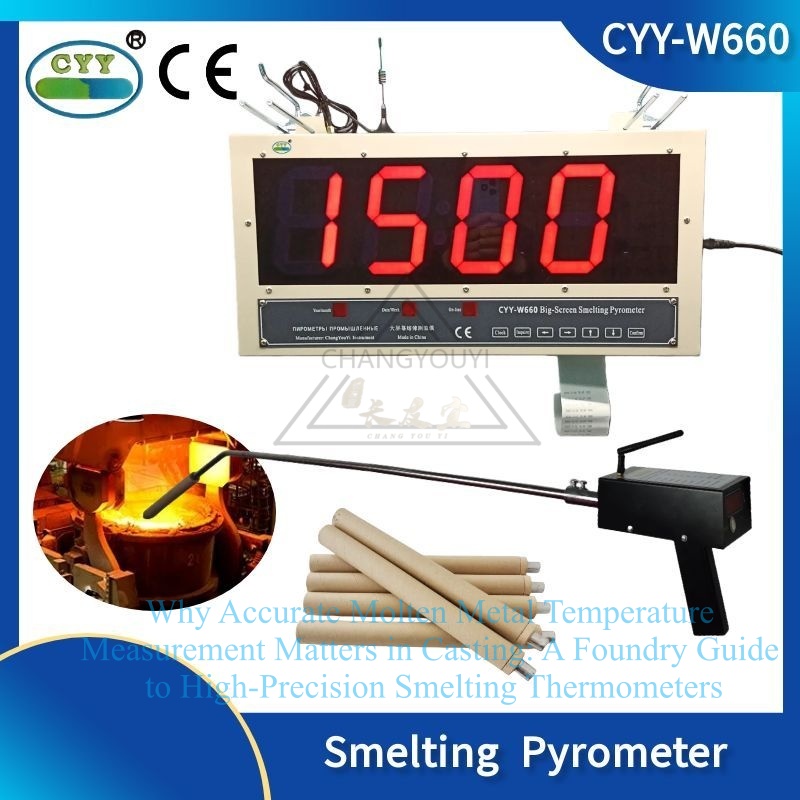
In practical molten steel temperature measurement or molten iron temperature measurement applications, this "thermocouple" is packaged inside a single-use fast-response thermocouple probe. The probe tip consists of fine thermocouple wires made from two specific alloys (such as platinum-rhodium and platinum), enclosed in a high-temperature ceramic protective tube.
The instant the probe is immersed in high-temperature molten metal (molten steel, molten iron, molten copper, or molten aluminum), the hot junction temperature rises rapidly, creating a large temperature differential with the instrument's cold junction at room temperature — and generating a corresponding thermoelectric voltage.
The high-precision measurement circuit inside the smelting thermometer (the secondary instrument) rapidly acquires and amplifies this weak millivolt-level signal. Using built-in algorithms and cold-junction compensation, it converts the signal into an intuitive digital temperature display. The entire process typically completes within 2–4 seconds, achieving instantaneous measurement of dynamic, high-temperature melts — whether via wireless or wired measurement.
2. Key Component Analysis: The Role of the Probe and the Intelligence of the Instrument
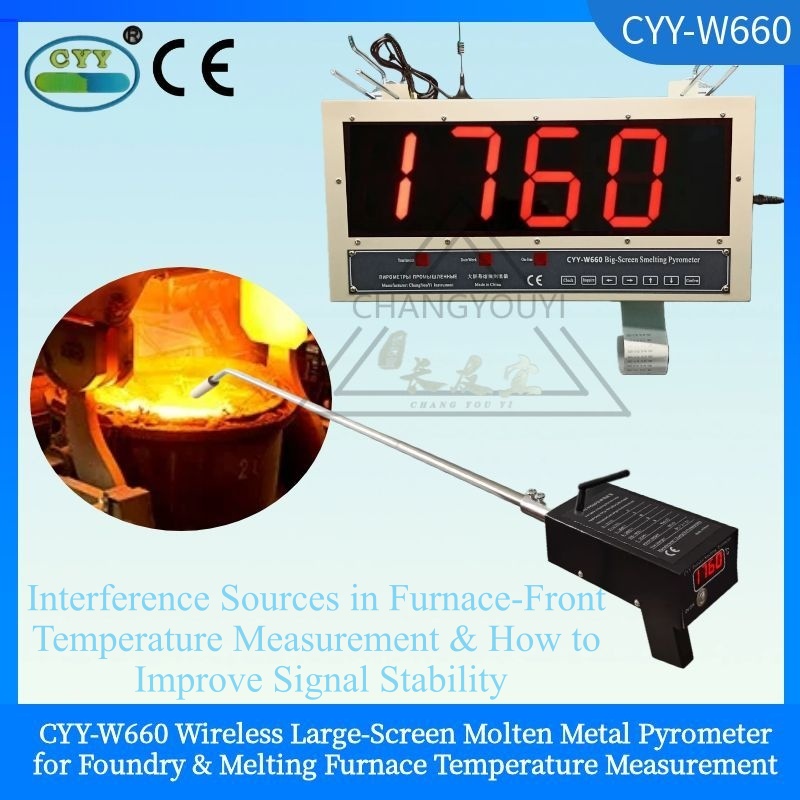
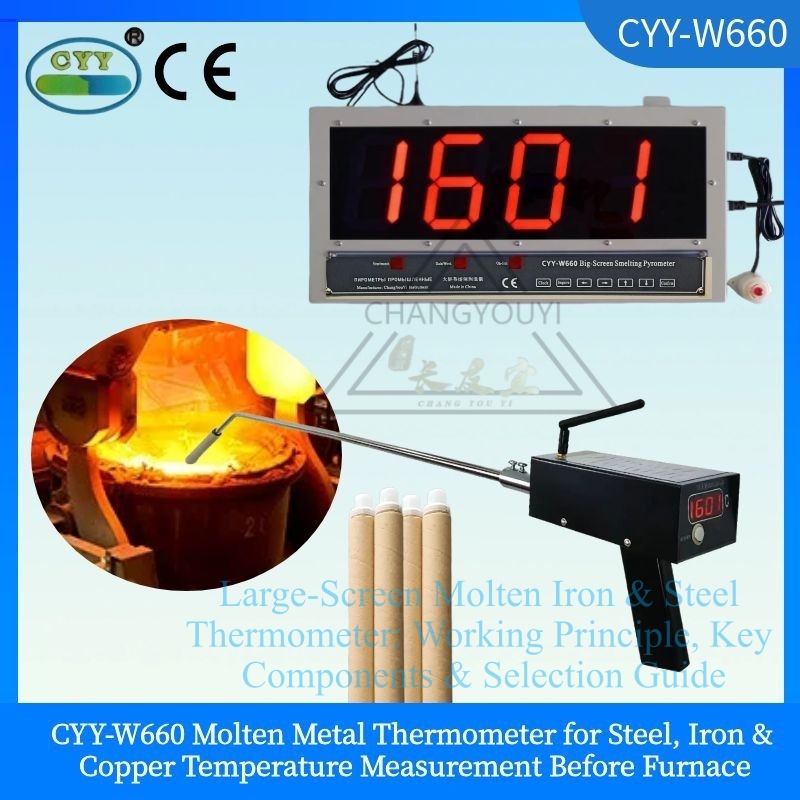
A complete furnace-front testing system typically consists of two main parts.
2.1 Fast-Response Thermocouple Probe (Consumable)
This is the part that directly contacts the high-temperature melt, and its quality determines the upper limit of measurement. A quality probe must provide:
Fast response — thermocouple wire material and structural design must ensure thermal equilibrium is reached within a short time
High-temperature resistance and corrosion resistance — the protective tube material (such as corundum or quartz) must withstand temperatures above 1600 °C and chemical attack from the melt
Stability and consistency — each probe's thermoelectric characteristics must be highly consistent to ensure reliable results
2.2 Measuring Instrument (Main Unit)
This is the "brain" of the system. Taking instruments produced by professional manufacturers such as Nanjing Changyouyi Analytical Instruments Co., Ltd. (CYY) as examples, their technical sophistication is reflected in:
High-precision A/D conversion — faithfully converting the thermocouple's analog signal into a digital signal
Intelligent algorithms and compensation — automatic cold-junction compensation and non-linear correction, eliminating environmental interference
Data storage and communication — recording historical temperature data and uploading it to management systems via wired or wireless modules for quality traceability and analysis
Robust, durable design — adapted to the high-temperature, dusty, and vibrating conditions of foundry workshops
3. Application Scenarios & Value
Furnace-front analysis is a systematic process in which smelting thermometers often work alongside carbon-silicon analyzers and other equipment to form a complete furnace-front testing system.
Foundry molten iron treatment — precise temperature measurement before and after nodularization and inoculation treatment is key to controlling treatment effectiveness and preventing degeneration. Combined with carbon and silicon content measured by thermal analyzers, composition can be adjusted precisely to avoid scrap
Steelmaking and continuous casting — temperature measurement during tapping, refining, and at the ladle/tundish stages is a core operation for controlling the smelting endpoint, ensuring continuous casting stability, and improving billet quality
Non-ferrous metal melting — in copper alloy and aluminum alloy melting, precise temperature control is critical for preventing element burn loss and ensuring uniform alloy performance
Case Study
A medium-sized foundry introduced multiple sets of furnace-front testing equipment, including intelligent thermometers and analysis systems supplied by CYY. Through standardized measurement points and data analysis, the foundry effectively reduced shrinkage porosity and gas porosity defects caused by improper temperature control, achieving a steady improvement in product pass rate.
4. Equipment Selection & Usage Recommendations
When faced with numerous furnace-front smelting thermometer brands on the market, users can evaluate options across the following dimensions:
Measuring range and accuracy — select an appropriate range and accuracy based on the metal being melted (iron, steel, copper, aluminum) and its maximum temperature; industrial-grade requirements typically call for error within ±2 °C
Reliability and stability — under complex foundry conditions, anti-interference capability, protection rating, and mean time between failures (MTBF) are important indicators
Operational convenience and intelligence — large-screen display, one-touch operation, and wireless data transmission significantly improve efficiency and reduce human error
Supplier professional service — including technical support, delivery response speed, and stable supply of consumables (probes, sample cups). Professional manufacturers such as Nanjing Changyouyi Analytical Instruments Co., Ltd. can supply not only equipment but also practical technical consulting and one-stop solutions grounded in its "mutual benefit and win-win cooperation" philosophy
5. Conclusion
The Large-Screen Molten Iron & Steel Thermometer may appear to be a "small" device on the shop floor, but it is an indispensable "big" tool for modern precision casting and efficient metallurgy. Behind it lies the integrated application of thermoelectric principles, materials science, and microelectronics technology.
Understanding its working principle helps users operate equipment more standardly and scientifically — building competitive advantage in the casting industry through stabilized processes, improved quality, and reduced losses. Selecting furnace-front analysis equipment that is well-designed, technically advanced, and stably operating — and establishing a standardized temperature measurement system — is foundational work that every metal melting workshop pursuing excellence should prioritize.
About the Technology Provider
Some of the technical principles and application practices in this article reference the technical accumulation of Nanjing Changyouyi Analytical Instruments Co., Ltd. (CYY) in the metallurgy and casting testing field. As an analytical instrument manufacturer integrating R&D, production, sales, and service, CYY's product range covers furnace-front carbon-silicon analyzers, smelting thermometers, intelligent spectrometers, and other furnace-front testing equipment — committed to providing reliable testing solutions for the steel, casting, and machinery industries.