Why Accurate Molten Metal Temperature Measurement Matters in Casting: A Foundry Guide to High-Precision Smelting Thermometers
Introduction
In casting production, smelting is the core stage that determines the final performance and quality of castings. The temperature of molten iron or molten steel, much like the "heat control" in cooking, directly influences the fluidity of the melt, its mold-filling ability, the solidification process, and ultimately the mechanical properties and internal soundness of the finished product.
However, many foundries — especially small and medium-sized plants — still face significant challenges in furnace-front temperature measurement: inaccurate readings, slow response, complex operation, and unstable equipment. These problems frequently cause pouring temperature to deviate from process requirements, leading to casting defects such as shrinkage porosity, gas porosity, cold shuts, and composition unevenness. The consequences include raw material waste, high rework rates, and even entire batch scrapping — all of which severely constrain production efficiency and economic returns.
Technical Pain Points: Why Precise Temperature Measurement Is Critical
Casting smelting is not a simple "melting" process — it is a complex physicochemical operation in which temperature is the single most critical process parameter. Inaccurate measurement triggers a chain of negative effects:
Too low temperature — melt fluidity deteriorates, leading to incomplete mold filling and defects such as cold shuts and misruns. It can also undermine the effectiveness of inoculation or nodularization treatments.
Too high temperature — energy consumption and furnace lining erosion both rise. The melt absorbs excessive gas and oxidizes severely, producing coarse grains, increased shrinkage porosity, hot tearing tendency, and burning loss of beneficial alloying elements.
Implementing fast, accurate, and reliable furnace-front temperature measurement is therefore the first checkpoint for stabilizing process technology and controlling product quality. Modern high-precision smelting thermometers are specifically designed to address these pain points.
Core Equipment Analysis: Key Technical Elements of a High-Precision Smelting Thermometer
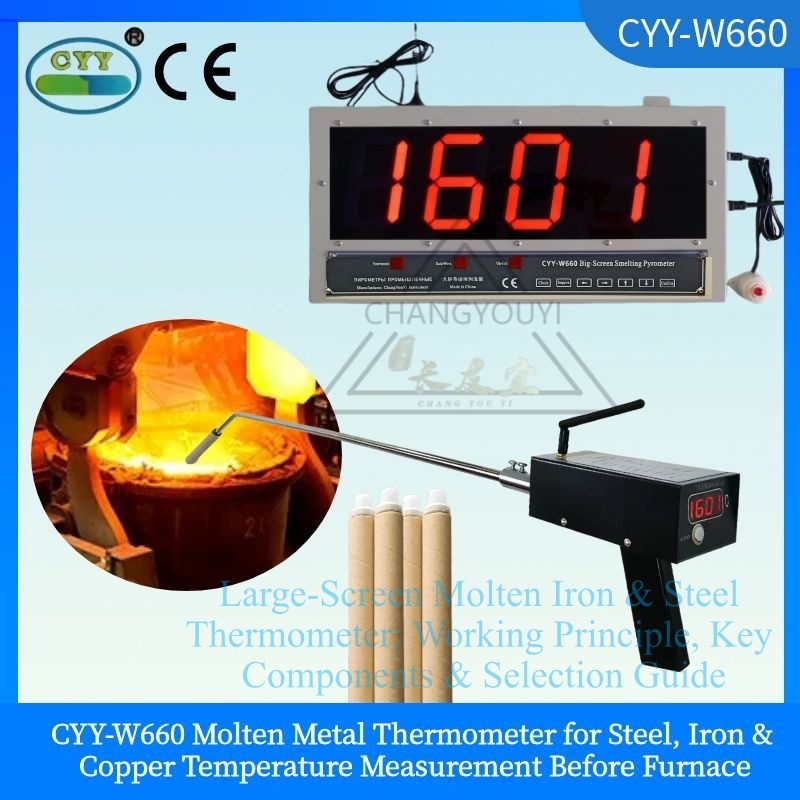
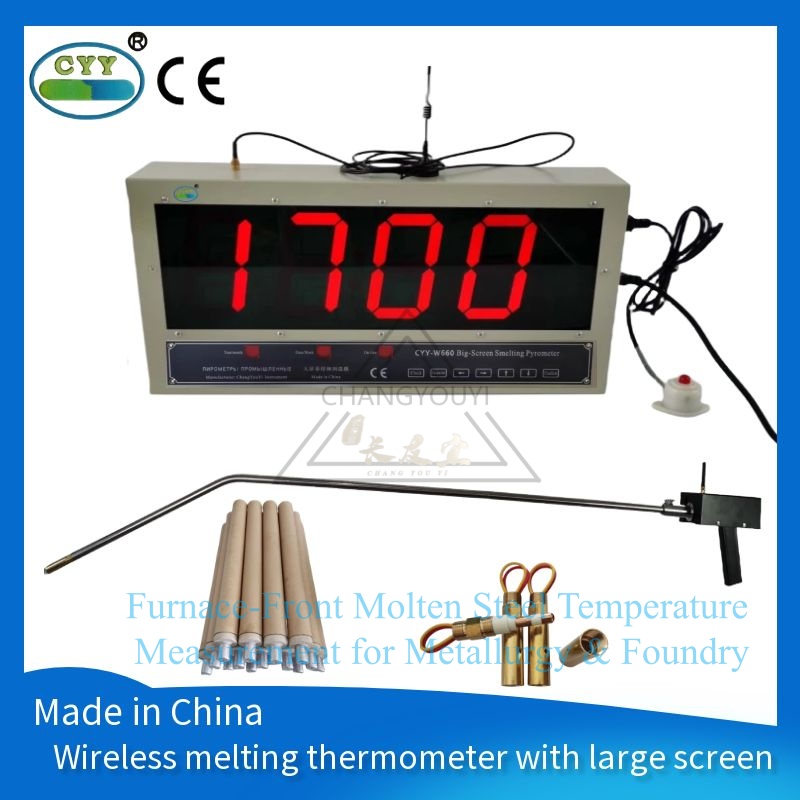
A complete furnace-front temperature measurement system typically consists of three parts: the thermometer main unit, a rapid-response thermocouple probe, and compensation cables. Its technical advantages are reflected in the following dimensions:
1. High-Precision Sensor and Rapid Response
Quality fast-response thermocouples generate thermoelectric voltage the instant their tip contacts high-temperature melt, with response times typically within 3–5 seconds. Combined with automatic cold-junction compensation and digital filtering inside the instrument, the system quickly locks onto the true temperature — avoiding reading deviations caused by melt cooling or environmental interference.
2. Intelligence and Stability
Modern smelting thermometers (or molten steel thermometers) feature built-in high-performance microprocessors with automatic stability detection, peak hold, data storage, and over-limit alarm functions. A clean, intuitive operator interface reduces human error. Anti-interference capability and long-term stability are essential for the high-temperature, dusty conditions of foundry workshops.
3. Wireless Technology
The introduction of wireless temperature measurement technology further enhances operational safety and convenience. Operators can read data from a safe distance, avoiding the risks of close-range high-temperature radiation and metal splash. Wireless transmission also simplifies data delivery to central control rooms, supporting centralized process data management and analysis.
4. System Integration and Expansion
Advanced furnace-front testing equipment does more than measure temperature. It can be combined with thermal analyzers and carbon-silicon analyzers for integrated workflows. After measuring molten iron temperature, for example, a thermal analyzer with a sample cup can rapidly determine carbon equivalent (CE), carbon content (C%), and silicon content (Si%) — providing immediate dual-parameter support for subsequent inoculation and nodularization processes. This delivers true "rapid furnace-front analysis."
Technical Performance Index
| No. | Parameter | Specification |
|---|---|---|
| 1 | Resolution (°C) | 1 |
| 2 | Response time (s) | 1 |
| 3 | Environmental conditions | Operating: Temperature 0–50 °C; Humidity 5–80 %RH |
| 4 | Storage conditions | Temperature −20–60 °C; Humidity 5–90 %RH |
| 5 | Wireless portable melting thermometer: DC 6 V ±10%; Large-screen wireless receiver display: AC 220 V ±10% | |
| 6 | Wireless transmitting/receiving distance | 0–300 m |
| 7 | Wireless transmitting frequency | 470 / 490 MHz |
| 8 | Large screen dimensions | 500 × 238 × 90 mm |
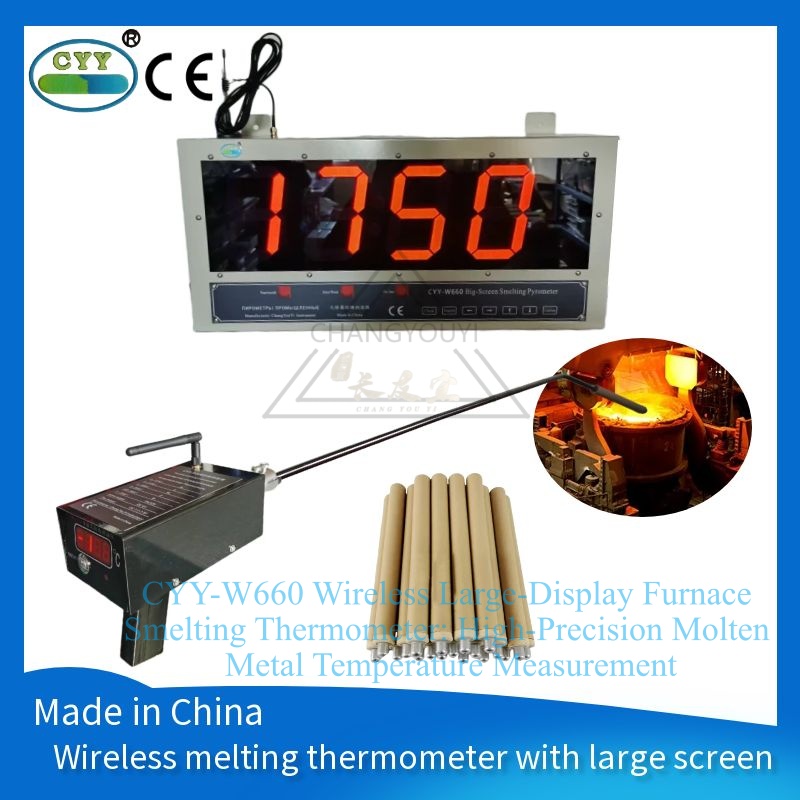
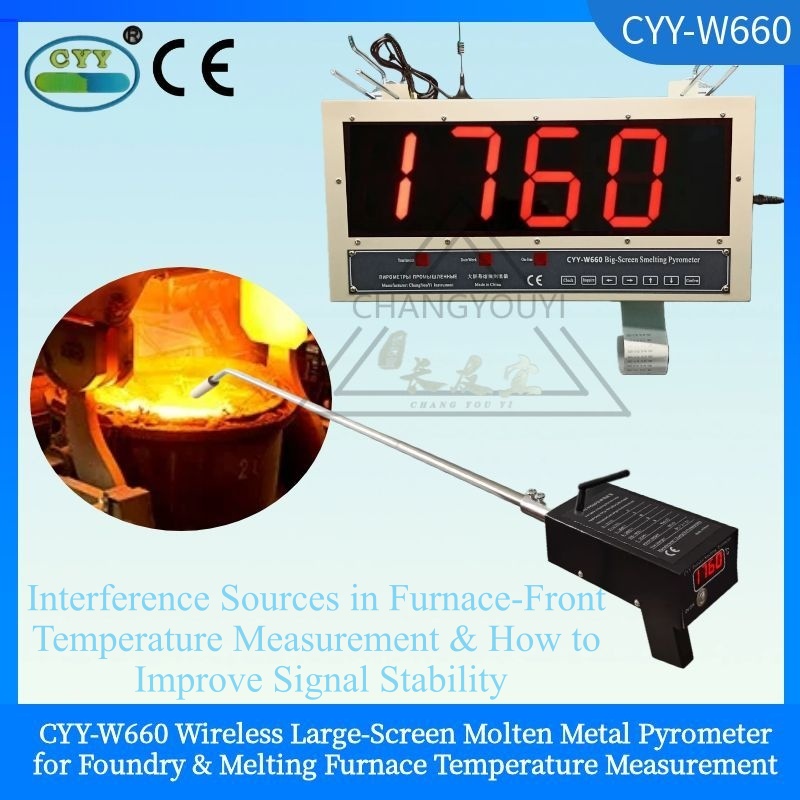
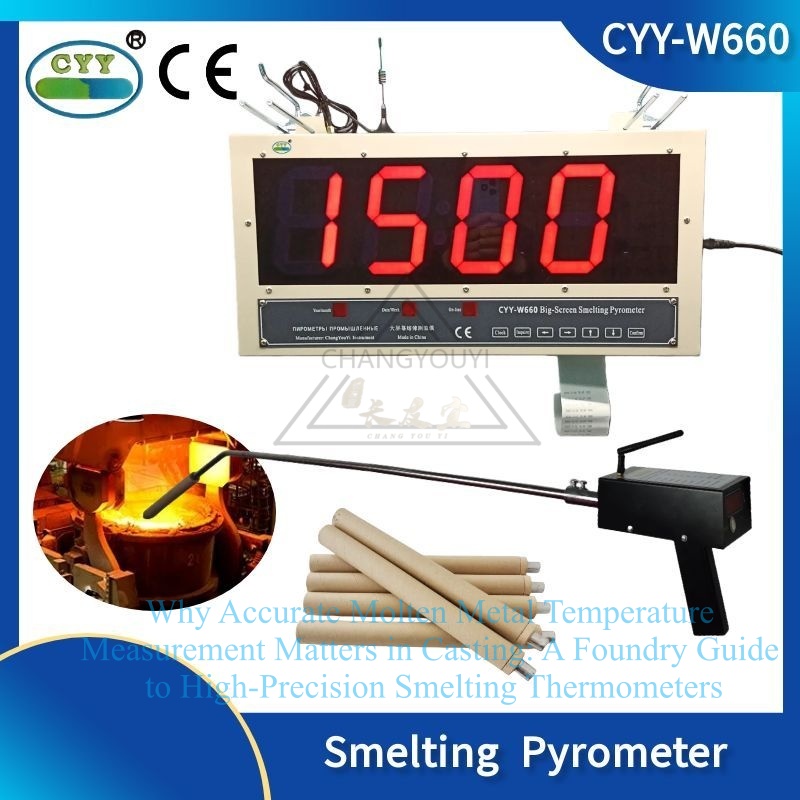
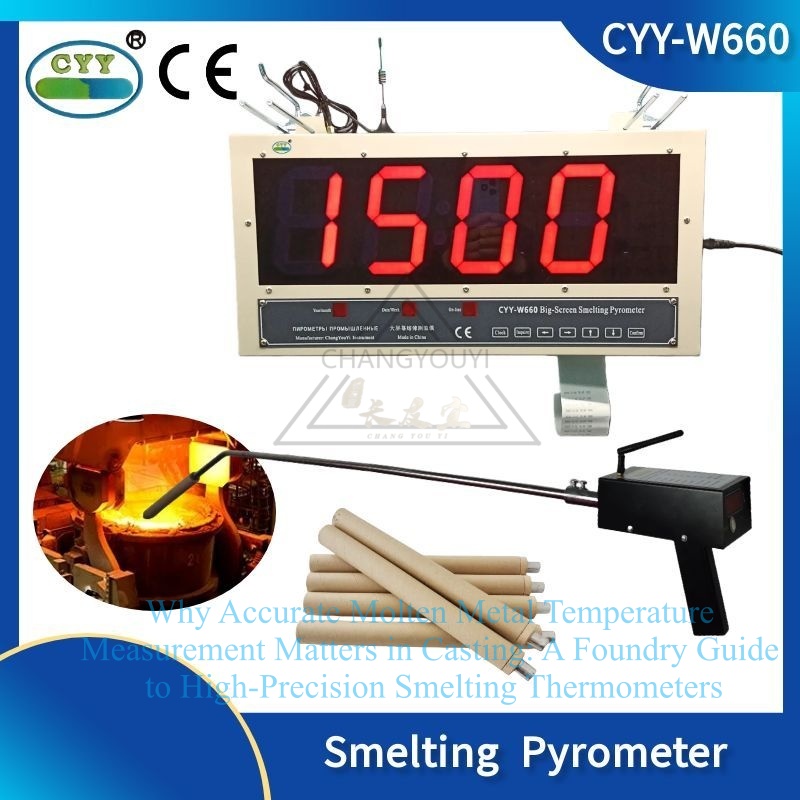
High-Accuracy Smelting Thermometer (CYY-W660 Series)
The high-accuracy smelting thermometer combines the flexibility of a handheld measuring instrument with the long-distance visibility of a wall-mounted large display — eliminating cable connections between the measurement lance and the display.
System Composition
W330 wireless portable melting thermometer with wireless transmission function
CYY-W660 large-screen display with wireless reception, featuring a 5-inch digital tube display with character height of 120 mm
Functional Highlights
Synchronized lighting cue and electric bell prompt at the end of measurement, with automatic hold of the measured value
Multi-alarm protection: broken thermocouple, over-range, and low-voltage alarms
Original professional data transmission module ensuring highly reliable wireless transmission
Advanced anti-interference design enabling measurement inside the furnace while the induction furnace is energized — no power interruption required
Stores over 1,000 historical records, with on-demand query and retrieval of historical temperature data
Optional thermal printer for full workshop oversight, supporting internal management
Application Scenarios & Value
In real foundry production, the value of high-precision smelting thermometers runs through multiple critical scenarios:
Melting tap control — accurately determine whether the melt has reached the target tapping temperature, ensuring that subsequent processes such as nodularization and inoculation occur within the correct temperature window
Pouring process monitoring — pre-pour or in-pour temperature checks ensure that every ladle and every mold meets the process card's pouring temperature requirement, guaranteeing casting quality consistency from the source
Process optimization and traceability — continuous, accurate temperature records give process engineers a reliable basis for optimizing melting curves and pouring system design. Every heat's data is traceable, simplifying quality analysis and problem investigation
Energy savings — avoiding unnecessary superheating directly reduces electricity or fuel consumption, reduces furnace lining erosion, and extends furnace life
Summary & Selection Recommendations
For foundries, investing in a reliable furnace-front testing system delivers returns far beyond the equipment itself. It means:
Improved quality stability — fewer scrap and rework events caused by temperature deviation, higher pass rate and consistency
Higher production efficiency — fast measurement reduces waiting time, and data-guided precise operations shorten production cycles
Lower overall cost — energy savings, less waste, and reduced quality instability risks
Stronger process control capability — lays the data foundation for digitalized, precision production management
When selecting smelting temperature measurement or molten iron temperature measurement equipment, foundries should focus on the following points:
Measurement accuracy and speed
Equipment stability in high-temperature, high-dust environments
Ease and safety of operation (consider wireless temperature measurement functions)
Supplier technical support and service capability
About Us
Nanjing Changyouyi Analytical Instruments Co., Ltd. (CYY) is a technology-driven enterprise specializing in the research, development, and production of metallurgical testing equipment, foundry inspection instruments, and industrial temperature measurement devices. The company is committed to providing reliable furnace-front testing solutions for the steel, casting, and machinery manufacturing industries. Product design emphasizes "Precision, Simplicity, Speed, and Stability" — helping customers achieve accurate process control and quality improvement through technological means and a responsible attitude.
We believe that reliable equipment is the cornerstone of process execution. If you have any questions regarding casting production process control, furnace-front analysis technology, or equipment selection, please feel free to contact us for technical exchange and discussion at any time.